The short answer
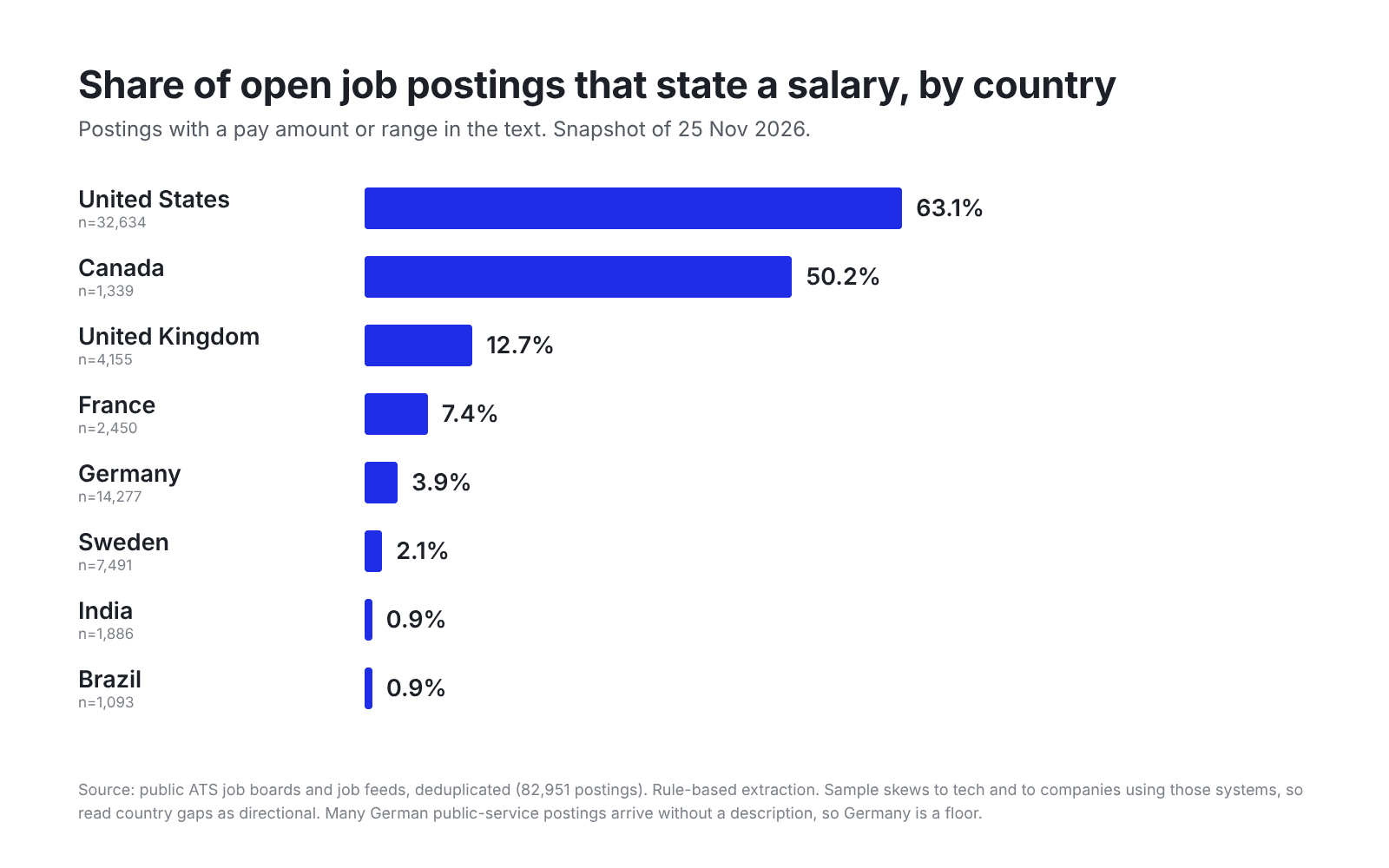
In 82,951 open job postings in the Career Copilot (getcareerscore.com) job index on November 25, 2026, 63.1% of US postings stated a salary (n=32,634), against 50.2% in Canada (n=1,339), 12.7% in the United Kingdom, 7.4% in France, 3.9% in Germany, 2.1% in Sweden, and 0.9% in both India and Brazil. The two leaders are the two countries where state or provincial laws require a pay range in the posting.
Snapshot of ; page updated . CC BY 4.0.
Share of job postings that state a salary, by country
| Country | State a salary | Postings | Pay-in-posting rule |
|---|---|---|---|
| United States | 63.1% | 32,63420,604 with pay | State laws |
| Canada | 50.2% | 1,339672 with pay | Provincial laws |
| United Kingdom | 12.7% | 4,155526 with pay | None yet; planned |
| France | 7.4% | 2,450182 with pay | EU directive |
| Germany | 3.9% | 14,277558 with pay | EU directive |
| Sweden | 2.1% | 7,491155 with pay | EU directive |
| Brazil | 0.9% | 1,09310 with pay | Not checked |
| India | 0.9% | 1,88617 with pay | Not checked |
Source: Career Copilot job index, November 25, 2026, 82,951 distinct postings. Laws checked on November 26, 2026; this is a summary, not legal advice.
Which laws require pay in job postings?
- United StatesNo federal rule. State laws require a pay range in postings, among them Colorado (since 1 January 2021), California and Washington (since 1 January 2023, employers with 15 or more staff) and New York State (since 17 September 2023, 4 or more staff).Sources: Colorado CDLE, INFO #9A; California SB 1162 (Labor Code 432.3); Washington RCW 49.58.110; New York State DOL FAQ.
- CanadaProvincial laws. British Columbia requires the expected pay or range in every public posting since 1 November 2023; Ontario requires it from employers with 25 or more staff since 1 January 2026.Sources: Government of British Columbia; Littler on Ontario.
- United KingdomNo legal duty yet. After a consultation in July 2026, the government said in November 2026 that it will legislate to require salary information in job adverts.Sources: Pinsent Masons; Mishcon de Reya.
- Germany, France and Sweden (EU)EU Pay Transparency Directive 2023/970: applicants must get the starting pay or range before the interview, in the vacancy notice or otherwise. Member states had to transpose it by 7 June 2026; we have not checked each national law.Sources: Directive (EU) 2023/970, EUR-Lex; National Law Review.
India and Brazil: we did not check their rules for this page. A summary as of November 2026, not legal advice.
Why do US and Canadian postings show pay so much more often?
Because the law asks for it in the places where many of their jobs are. In the United States there is no federal rule, but Colorado has required a pay range in postings since 2021, California and Washington since 2023 for employers with 15 or more staff, and New York State since September 2023 for employers with four or more. In Canada, British Columbia has required the expected pay in every public posting since November 2023, and Ontario since January 2026 for employers with 25 or more staff.
We count postings by country, not by state or province, so the table cannot show how much of each figure the laws explain. It shows the gap, not its cause.
What changes in the EU and the UK?
The EU Pay Transparency Directive (Directive (EU) 2023/970) gives job applicants the right to know the starting pay or its range before the interview, either in the vacancy notice or in another way, and bans asking about pay history. Member states had to put it into national law by 7 June 2026, and not all did so on time. Because the directive allows the information to come after the advert, a low share in postings does not by itself mean an employer is breaking it. This snapshot, taken in November 2026, is a baseline for Germany, France and Sweden as national rules take effect.
The United Kingdom is not covered by the directive. As of November 2026 there is no legal duty to state pay in a UK advert; the government has said it will legislate for one after a consultation held in July 2026.
How we counted
- Sample: every posting open in the Career Copilot job index on November 25, 2026, 82,951 after removing duplicates listed on more than one board, from 10,581 employers and 17 sources. Countries are the eight with the most postings.
- A posting states a salary when its text has an amount with a currency, as a range or a single figure. Funding, revenue, bonus and budget amounts are skipped. The rules are fixed and the same for every country.
- 32,117 postings (38.7%) reach the index with a title and location but no description, mostly from SmartRecruiters boards, the German public employment service and USAJOBS. They cannot state a salary, so every share is a floor; Germany is the most affected. Among postings with a description, 37.3% state a salary, against 30.3% of all postings.
- Our sources lean towards technology employers and remote-first companies in the US and Europe, plus the German and Swedish public employment services, so the shares describe this index, not every job in each country. India and Brazil have small samples.
- Other counts differ. Indeed Hiring Lab (May 2026) found that over half of UK postings on Indeed include salary information, against about 1 in 8 in Germany. Our shares, the UK's above all, are much lower because our index draws mainly on employers' own career boards, which lean towards technology firms, and few agency or recruiter adverts, where pay is stated more often. Read our numbers as what employers publish on their own career sites, not the whole job market.
- The numbers are frozen with the Q4 2026 report and will not change; the next edition will be a new page. Full method: the report's method section.
The same snapshot feeds the full Job Market Report, Q4 2026, which also has salaries by role and the share stating pay by role family. Our methodology explains how the job index is built.
Download the data
The table above as a CSV, one row per country, free under Creative Commons Attribution 4.0, with credit to Career Copilot and a link to this page. No sign-up.
Cite this page
Reference (APA style)
Career Copilot. (2026, November 26). Pay transparency by country: Share of job postings that state a salary, Q4 2026 [Data set]. getcareerscore.com. https://www.getcareerscore.com/pay-transparency-by-country
HTML credit link
Source: <a href="https://www.getcareerscore.com/pay-transparency-by-country">Career Copilot, pay transparency by country (Q4 2026)</a> (Career Copilot, November 26, 2026, CC BY 4.0)Free to reuse under CC BY 4.0 with credit and a link. Charts, method notes and a press contact are in the press kit.
Questions
Which country's job postings show salaries most often?
In our snapshot of 82,951 open postings on November 25, 2026, the United States: 63.1% of 32,634 US postings stated a salary, ahead of Canada at 50.2%. Both have state or provincial laws that require a pay range in postings.
Do job ads in the EU have to show a salary now?
The EU Pay Transparency Directive (2023/970) gives applicants the right to the starting pay or its range before the interview, through the vacancy notice or otherwise, so it does not strictly require the figure in the advert itself. Member states had to make it national law by 7 June 2026, and the exact rules depend on each country's law.
Why is Germany so low?
Partly our data: many German postings, mostly from the public employment service, reach our index without a description, so a stated salary cannot be read from them. 3.9% is therefore a floor. The rest is employers' practice, which national rules under the EU directive may change.
Can I use these numbers?
Yes. The table and the CSV are under Creative Commons Attribution 4.0: use them in articles, research and teaching with credit to Career Copilot (getcareerscore.com) and a link to this page.
Looking for a job that states its pay? The jobs pages list open roles from the same index, and the salary calculator estimates US base pay by role and level.