This page explains where every number on Career Copilot (getcareerscore.com) comes from: the two resume scores, the match rate for a job, and the job index behind the jobs, company, skills and report pages. If a number on the site disagrees with this page, the page is wrong and I want to know: tell me.
The two resume scores
A resume check returns an ATS compatibility score and a resume quality score, both from 0 to 100. The ATS score is measured from the extracted text and the file's layout, with the same section, contact and date detection as the “What the ATS read” panel, so the same file always gets the same ATS score. Every problem that panel lists costs points: a high one at least 10, a medium one at least 6, so a file with either cannot score 95 or more. The quality score adds an AI reviewer's judgement (run at temperature 0), so it can move by a point or two between checks of the same file.
| Check | Points |
|---|---|
| Readable text | 16: no page that is a picture of text (−14), no undecodable or “fancy” characters (−10), 150 words or more (−10) |
| Contact details | 18: an email address 12, a phone number 6, in the text a parser reads (not a Word header) |
| Standard headings | 20: Experience 10, Education 6, Skills 4, under names a parser recognises |
| Dates | 18: date ranges such as “Mar 2021 – Present” 15; month and year rather than years only 3 |
| Layout safety | 14: two columns, a text box or a skipped Word header −10 each; text in the page margin, a table, a hidden link or body text under 10 pt −6 each |
| Skills findable | 10: a Skills section with 10 or more items; skills named only in the text earn up to 3 |
| Length | 4 for 150 to 1,100 words; 2 up to 1,600 |
The quality score is how the writing reads, judged and measured; the ATS score is not part of it. An AI model (Anthropic's Claude) reads the resume, takes the target role you give or, if you give none, the job titles in your experience (never the line with your name), and rates five criteria from 1 to 5: impact (results, not duties), specificity (tools, scope, numbers), focus (a clear target role), evidence (skills backed by experience) and writing. That rating makes up 60% of the score. 40% is measured writing: the share of bullets with a number (40 of those points), the share that open with an action verb (25), a summary section (15) and the absence of clichés such as “team player” or “responsible for” (20). The total is scaled so a flawless resume lands on 90, because there is always something to tailor for a specific job.
The missing keywords, weak sections and the ranked fixes come from the same AI review, written about the lines in your resume. A fix that names a field, a role or a line the resume does not contain, or points away from the role you gave, is dropped. When the AI service is unavailable, the ATS score is the same, and the judgement half of quality is replaced by two counts: skills named and bullet points, less for a resume past 900 words.
The match rate for one job
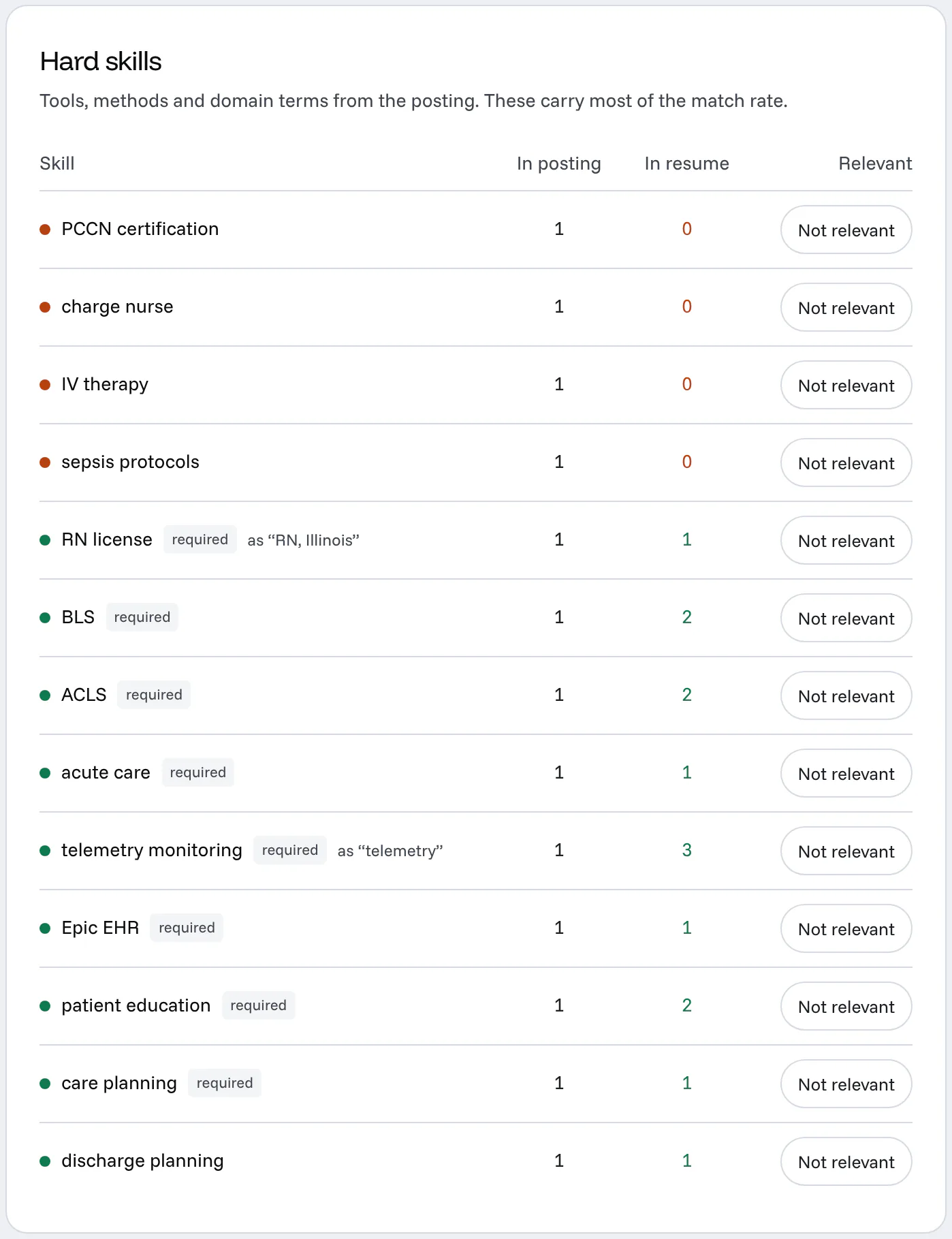
When you check a resume against a posting, the AI model reads both and reports the skills the posting names (how often, and whether each is required), whether your resume shows each one, and a list of pass, warning and fail checks. The match rate is then computed from those counts with fixed weights, so you can see why it moves:
- Hard skills from the posting found in the resume: 60%. Each skill counts as often as the posting names it, and a required skill counts double.
- Searchability checks an ATS runs (contact details, section headings, job title, date format, readable text): 20%. A pass counts fully, a warning half.
- Soft skills from the posting found in the resume: 10%.
- Recruiter checks (measurable results, action verbs, length, clichés, seniority): 10%.
You can mark a skill as not relevant to you, and it leaves the calculation.
How the scoring is tested
Scoring changes are run against an evaluation set before they ship: realistic resumes for 12 professions (software engineer, data analyst, nurse, sales account executive, SAP Basis consultant, teacher, chef, accountant, HR generalist, warehouse supervisor, UX designer and customer service), four of them in a strong and a weak version, matched against real postings from the index. It checks that a strong resume beats a weak one, that a resume matches its own field above an adjacent one and an adjacent one above an unrelated one, that contact details and dated roles are parsed, and that every profession gets recommended jobs mostly in its own field. In the latest run, on November 26, 2026, it passed 159 of 159 checks; an earlier run on November 25, with a different set of checks, passed 183 of 183. In an earlier round, re-checking the same resume moved the quality score by about 1.7 points on average.
The job index
The jobs, company, skills and report pages are built from one job index. It reads employers' own career sites (Greenhouse, Lever, Ashby and SmartRecruiters job boards), public employment services (the Bundesagentur für Arbeit in Germany, Arbetsförmedlingen JobTech in Sweden and USAJOBS) and remote job boards. The same job listed in two places is kept once, using a key of company, title and location. A listing not seen for three days is dropped, and the pages are rebuilt every six hours. Today the index holds about 134,000 open postings. These are the employers we index, not a sample of the whole job market: the sources lean towards technology employers and remote-first companies in the US and Europe.
Not every posting comes with its description. On November 25, 2026, 32,117 of 82,951 postings (39%) had a title and location only, mostly from SmartRecruiters, the Bundesagentur and USAJOBS. Those cannot state pay, skills or sponsorship, so shares of those are computed over the postings with text, and the pages say so.
Jobs, company and skills pages
- Jobs pages (by role, city and remote) list the live postings that match a role's title rules and link to the employer's own posting; we do not mark them up as our job ads. A page exists with 8 live postings and is linked from the jobs hub from 20 for a role, 30 for a city and 50 for remote. Since November 27, 2026 none of them is put forward to search engines: every role, city and remote page is noindex and out of the sitemap, because most of what it shows is other sites' listings, often in German or Swedish. The jobs hub itself stays indexed.
- Company pages merge name variants (“Acme, Inc.” and “ACME GmbH”) into one employer. A page exists from 5 open roles. Only 50 are indexable and in the sitemap: the employers with the most open roles whose postings come from their own applicant tracking board (Greenhouse, Lever, Ashby, SmartRecruiters), not from public job services or job boards. Every other company page stays open to visitors with noindex; staffing agencies are never indexable. The applicant tracking system shown is the board we fetched the postings from, never a guess.
- Skills pages count a vocabulary of 530 skills (version 2026-11-25.6), each with its spellings and acronyms, matched as whole words in descriptions of at least 300 characters. Web addresses are removed first, and words that mostly appear in benefits, legal or company-description text are not counted as skills. One employer contributes at most 5 postings to a role, so one company's standard text cannot set the numbers. A role needs 30 usable postings for data on its page. Only the hand-written role pages are indexable; the pages built from the counts alone stay open to visitors with noindex until their vocabulary and sample are cleaned up. The current counts are from November 25, 2026, from 48,679 postings with a full description.
Reports
The Q4 2026 job market report counts 82,951 distinct postings open in the index on November 25, 2026 (82,978 rows from 17 sources, duplicates removed). Its figures were computed once by a script and stored with the page, so they do not change as the live index does; that is why the live count above differs from the report. The method section of the report gives the full rules, and every table is in a free CSV under CC BY 4.0.
Known limits
- No resume checker has access to a given employer's ATS configuration. Treat the ATS score as a strong signal, not a pass or fail.
- Rules for salary, remote and hybrid miss some postings written in unusual ways; treat small differences as noise.
- Shares describe this index, not every job in a country.
- Sample resumes and letters in the guides are illustrations; their people, employers and numbers are invented.
Corrections
- November 27, 2026: we stopped putting forward pages that are mostly other sites' listings. All jobs pages, the skills pages built from counts alone, and every company page outside the 50 largest employers hiring through their own applicant tracking system are now noindex and out of the sitemap; they still work for visitors. Two spellings of one employer, Unitedmedia and United Media, had separate company pages; the first now redirects to the second.
- November 27, 2026: /ai-resume-score described the score as four equally framed factors that did not match the weights on this page; it now uses the same breakdown. The 2026 tech job market report replaced figures taken from vendor and SEO blogs with government, peer-reviewed and labelled vendor sources. A claim that 91% of hiring managers are open to career breaks was removed from the employment gap guide because we could not trace it to a survey.
- November 26, 2026: three blog posts showed publish dates in February, March and April 2026, and two interview guides showed August 23, 2026, all earlier than the pages existed. They now show their real publish date, August 27, 2026.
- November 25, 2026: the Q4 report and the skills pages were recounted with stricter role and skill rules on the day of publication. Site reliability engineers had been counted as quality engineers, retail shift leads as production supervisors, and words such as “stakeholders” and “audit” as skills wherever they appeared. Details are in the report's method section.
Found something wrong? Email support@getcareerscore.com. How corrections are handled is in the editorial policy.